
NDA Format India 2026: Free Non Disclosure Agreement Template


A non-disclosure agreement (NDA) is a contract in which one or both parties promise to keep shared business information confidential and use it only for an agreed purpose. Below is a complete NDA format drafted for Indian law that you can copy or download in Word, followed by the changes you need for a one-way or employee version.
Most NDA templates online are written for the US or UK and ignore three things that decide whether an NDA holds up in India: Section 27 of the Indian Contract Act, state stamp duty, and how the confidentiality clause is drafted. This guide covers all three, so the format you sign is one you can actually enforce.
It is written for founders sharing a pitch or product with a partner, MSMEs onboarding vendors or freelancers, and employers protecting customer lists and pricing.
What Is a Non Disclosure Agreement?
A non disclosure agreement is a contract that creates a legal duty to keep specified information secret. It defines what counts as confidential, who may see it, what it may be used for and for how long the duty lasts.
In India an NDA is an ordinary contract under the Indian Contract Act, 1872. It needs the usual ingredients of a valid contract: free consent, lawful consideration and a lawful object. The mutual promises of confidentiality, or the opportunity to evaluate a deal, are generally treated as sufficient consideration.
NDAs are commonly used:
- Before sharing a product, prototype or business plan with a potential partner, manufacturer or acquirer
- When hiring freelancers, agencies or developers who will see source code, designs or customer data
- When onboarding employees with access to pricing, formulas or client lists
- During due diligence for a loan, investment or acquisition
- Before sharing tender, bid or vendor pricing information
Non Disclosure Agreement Format (Full Text)
The format below is a mutual NDA, which suits most business-to-business discussions. Replace everything in square brackets. A one-way and employee variant follow after it.
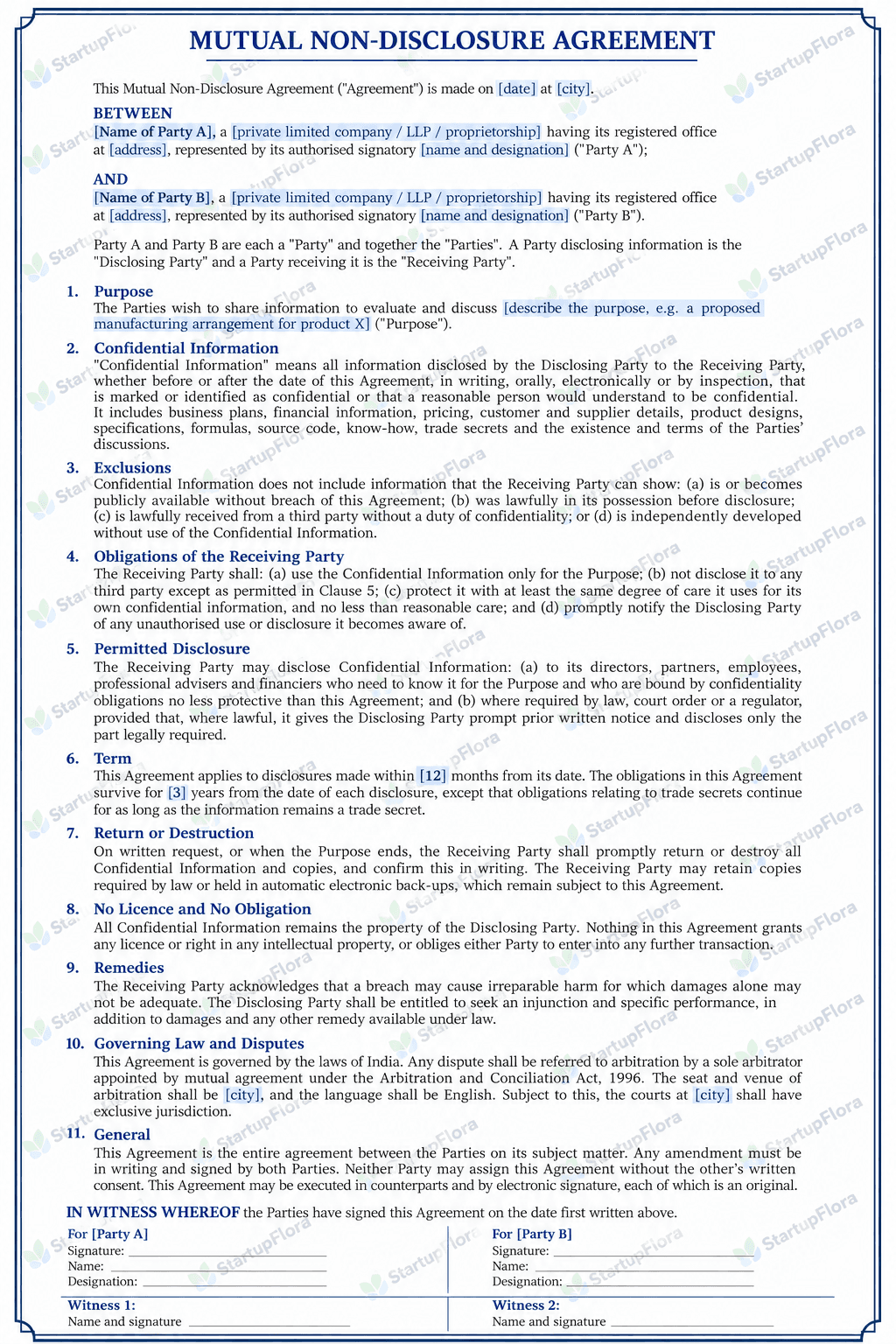
MUTUAL NON-DISCLOSURE AGREEMENT
This Mutual Non-Disclosure Agreement ("Agreement") is made on [date] at [city].
BETWEEN
[Name of Party A], a [private limited company / LLP / proprietorship] having its registered office at [address], represented by its authorised signatory [name and designation] ("Party A");
AND
[Name of Party B], a [private limited company / LLP / proprietorship] having its registered office at [address], represented by its authorised signatory [name and designation] ("Party B").
Party A and Party B are each a "Party" and together the "Parties". A Party disclosing information is the "Disclosing Party" and a Party receiving it is the "Receiving Party".
1. Purpose The Parties wish to share information to evaluate and discuss [describe the purpose, e.g. a proposed manufacturing arrangement for product X] ("Purpose").
2. Confidential Information "Confidential Information" means all information disclosed by the Disclosing Party to the Receiving Party, whether before or after the date of this Agreement, in writing, orally, electronically or by inspection, that is marked or identified as confidential or that a reasonable person would understand to be confidential. It includes business plans, financial information, pricing, customer and supplier details, product designs, specifications, formulas, source code, know-how, trade secrets and the existence and terms of the Parties' discussions.
3. Exclusions Confidential Information does not include information that the Receiving Party can show: (a) is or becomes publicly available without breach of this Agreement; (b) was lawfully in its possession before disclosure; (c) is lawfully received from a third party without a duty of confidentiality; or (d) is independently developed without use of the Confidential Information.
4. Obligations of the Receiving Party The Receiving Party shall: (a) use the Confidential Information only for the Purpose; (b) not disclose it to any third party except as permitted in Clause 5; (c) protect it with at least the same degree of care it uses for its own confidential information, and no less than reasonable care; and (d) promptly notify the Disclosing Party of any unauthorised use or disclosure it becomes aware of.
5. Permitted Disclosure The Receiving Party may disclose Confidential Information: (a) to its directors, partners, employees, professional advisers and financiers who need to know it for the Purpose and who are bound by confidentiality obligations no less protective than this Agreement; and (b) where required by law, court order or a regulator, provided that, where lawful, it gives the Disclosing Party prompt prior written notice and discloses only the part legally required.
6. Term This Agreement applies to disclosures made within [12] months from its date. The obligations in this Agreement survive for [3] years from the date of each disclosure, except that obligations relating to trade secrets continue for as long as the information remains a trade secret.
7. Return or Destruction On written request, or when the Purpose ends, the Receiving Party shall promptly return or destroy all Confidential Information and copies, and confirm this in writing. The Receiving Party may retain copies required by law or held in automatic electronic back-ups, which remain subject to this Agreement.
8. No Licence and No Obligation All Confidential Information remains the property of the Disclosing Party. Nothing in this Agreement grants any licence or right in any intellectual property, or obliges either Party to enter into any further transaction.
9. Remedies The Receiving Party acknowledges that a breach may cause irreparable harm for which damages alone may not be adequate. The Disclosing Party shall be entitled to seek an injunction and specific performance, in addition to damages and any other remedy available under law.
10. Governing Law and Disputes This Agreement is governed by the laws of India. Any dispute shall be referred to arbitration by a sole arbitrator appointed by mutual agreement under the Arbitration and Conciliation Act, 1996. The seat and venue of arbitration shall be [city], and the language shall be English. Subject to this, the courts at [city] shall have exclusive jurisdiction.
11. General This Agreement is the entire agreement between the Parties on its subject matter. Any amendment must be in writing and signed by both Parties. Neither Party may assign this Agreement without the other's written consent. This Agreement may be executed in counterparts and by electronic signature, each of which is an original.
IN WITNESS WHEREOF the Parties have signed this Agreement on the date first written above.
For [Party A] — Signature: ________ Name: ________ Designation: ________
For [Party B] — Signature: ________ Name: ________ Designation: ________
Witness 1: Name and signature ________ Witness 2: Name and signature ________
Download NDA Format in Word
The same format, with the one-way and employee clauses as alternatives, is available as an editable Word file: Download NDA Format (Word)
Print it on e-stamp paper of the value applicable in your state, or attach the e-stamp certificate as the first page before signing.
Mutual NDA Format vs One-Way NDA Format
| Basis | Mutual NDA | One-Way NDA | Employee NDA |
| Who shares information | Both parties | Only one party | Employer only |
| Who is bound | Both parties | Only the receiving party | The employee |
| Typical use | Joint ventures, partnerships, supply or distribution talks | Hiring a vendor, freelancer, agency or consultant | Staff with access to sensitive information |
| Purpose clause | The proposed deal | The services or evaluation | The employment |
| Term | Fixed years after disclosure | Fixed years after disclosure | During employment and a fixed period after |
One-Way Change
To convert the format into a one-way NDA, name one party as the Disclosing Party and the other as the Receiving Party throughout. Delete the reciprocal wording in the opening definitions. Every other clause can stay as it is.
Employee Change
For employees, replace the Purpose with the employment and add a duty to return laptops, files and credentials on exit. Do not add a clause stopping the employee from joining a competitor after leaving.
Is an NDA Legally Binding in India?
Yes. An NDA that meets the requirements of a valid contract is legally binding in India. Whether you can enforce it in practice depends on four points.
Section 27
Section 27 of the Indian Contract Act voids agreements that restrain a person from carrying on a lawful trade or profession. Confidentiality obligations are generally upheld, but post-termination non-compete clauses are generally void.
Stamp Duty
An NDA must be stamped under the applicable state Stamp Act. An unstamped NDA is not void, but a court will not admit it in evidence until the deficit duty and penalty are paid.
Clear Definition
Courts enforce what is clearly defined. An NDA calling "all information" confidential is harder to enforce than one listing categories such as pricing, formulas, designs and customer lists.
Proof of Breach
You must show what was disclosed and how it was misused. Keep a record of what you shared, when and with whom, such as emails, data-room logs or signed disclosure schedules.
Stamp Duty on NDA
Stamp duty on an NDA is a state subject, so the amount depends on the state where the agreement is executed. Most states treat an NDA under the general article for agreements, which usually attracts a modest fixed duty rather than a percentage.
In 2023 a seven-judge bench of the Supreme Court held that an unstamped or insufficiently stamped agreement is not void. The defect is curable by paying the duty and penalty, but until then the document cannot be relied on as evidence.
Practical steps:
- Check your state's current duty for an "agreement or memorandum of an agreement" on the state e-stamping or registration portal.
- Buy an e-stamp certificate in the name of either party before signing.
- Sign on or after the date of the e-stamp, never before it.
- Where parties sign in different states, the duty is generally decided by where the document is executed. Take advice if the amounts differ significantly.
How to Execute an NDA
Pick Variant
Decide whether both sides are sharing information (mutual), only you are (one-way), or the recipient is an employee. Using the wrong variant creates obligations you do not need.
Define Purpose
Write the specific deal or work the information is shared for. A narrow purpose clause is what makes misuse provable, because any other use is automatically a breach.
Fill Details
Enter correct legal names, registered addresses and authorised signatories. For a company or LLP, the signatory should hold a board resolution or authority letter permitting them to sign.
Pay Stamp
Purchase e-stamp paper of the correct value for your state before signing. Attach the certificate as the first page, or print the agreement directly on it.
Sign and Store
Sign physically with two witnesses or through a recognised electronic signature such as Aadhaar eSign. Store the signed copy with a log of everything disclosed under it.
Benefits of Using an NDA
Deal Safety
An NDA lets you share pricing, designs or financials during negotiations without losing control of them if the deal does not proceed. Without it, protection rests only on general law.
Clear Boundaries
The receiving party knows exactly what is confidential, who may see it and for how long. This prevents most disputes, which arise from misunderstanding rather than deliberate misuse.
Legal Remedy
A signed NDA gives you a contract claim for damages and the right to seek an injunction. Proving a breach of an express clause is far easier than relying on general equitable principles.
Vendor Discipline
Freelancers, agencies and manufacturers who sign an NDA treat your files with more care. It also sets an expectation that their own staff and subcontractors will be bound.
Investor Readiness
Investors and lenders check whether key employees and vendors are under confidentiality obligations. Signed NDAs on file show that your know-how and customer data are protected.
NDA Mistakes to Avoid
Hidden Non-Compete
Adding "shall not work with any competitor for two years" to an NDA does not make it enforceable. It can also weaken the confidentiality clauses around it in a dispute.
Vague Scope
Defining confidential information as "everything discussed" invites the argument that nothing specific was protected. List categories and mark key documents confidential when sharing them.
Unstamped Copy
Many Indian NDAs are signed on plain paper. If you ever need to enforce one, you will first pay the deficit duty with penalty and lose time before relief.
No End Date
An NDA without a clear term creates uncertainty. Use a fixed term after each disclosure, and keep only genuine trade secrets protected for as long as they stay secret.
Pushing Investors
Most venture capital funds and many angel investors in India decline to sign NDAs at pitch stage. Share a pitch deck that does not reveal core know-how instead of insisting.
Frequently Asked Questions
What is the format of a non disclosure agreement? An NDA format contains party details, the purpose, a definition of confidential information, exclusions, obligations of the receiving party, permitted disclosures, term, return of information, remedies, governing law and signatures.
Is an NDA legally binding in India? Yes, if it meets the requirements of a valid contract under the Indian Contract Act, 1872. Confidentiality clauses are generally enforceable, but post-termination non-compete clauses are generally void under Section 27.
Is stamp paper required for an NDA? Yes. Stamp duty is payable under the relevant state's Stamp Act. An unstamped NDA is not void, but it cannot be admitted in evidence until the duty and penalty are paid.
Can an NDA be signed online? Yes. Electronic signatures, including Aadhaar-based eSign, are recognised under the Information Technology Act, 2000. Stamp duty still applies, so attach an e-stamp certificate to the electronically signed document.
What is the difference between a mutual and one-way NDA? In a mutual NDA both parties share and protect each other's information. In a one-way NDA only one party discloses, and only the recipient is bound.
How long does an NDA last? Usually two to five years after each disclosure. Trade secrets such as formulas or source code can be protected for as long as they remain secret.
Can an employer stop an employee from joining a competitor through an NDA? Generally no. A clause restraining an employee from working elsewhere after leaving is generally void under Section 27. The employer can still stop the employee using or disclosing confidential information.
What happens if someone breaches an NDA? The disclosing party can claim damages for the loss caused and apply to court for an injunction restraining further use or disclosure. If the NDA has an arbitration clause, the claim goes to arbitration.
Do I need a lawyer to make an NDA? Not for a standard business discussion. The format above covers common cases. A lawyer is worth involving for high-value technology, acquisitions or cross-border deals.
Should I ask an investor to sign an NDA? Most investors in India decline NDAs at the pitch stage because they see many similar ideas. Share a deck that explains the business without revealing core know-how.
Conclusion
A non disclosure agreement protects your information only when it is drafted for Indian law. That means a clear definition of what is confidential, a specific purpose, a fixed term, correct stamping and no disguised non-compete clause.
Use the mutual format for two-way discussions, convert it to one-way for vendors and freelancers, and use the employee variant without post-exit restrictions. Keep a record of what you disclose, because that record is what proves a breach.
If you need an NDA adapted to a specific deal, a manufacturing arrangement or your employee onboarding.