
Business Loan Document Checklist: What to Verify Before You Submit
Most document lists online tell you what to collect. That is the easy part. Files usually come back for a different reason: something on the list was there, but it was wrong.
Examples include a PAN that spells your name differently from your GST certificate, an ITR that doesn't match your turnover claim, or a bank statement for only one of your three accounts.
This checklist has two columns that matter: the document, and what to check on it before it leaves your hands. Print it, tick it off, and your file will reach the credit officer the way you intended.
Note: Each bank and NBFC sets its own document list. Use this as your base list, then ask your lender for their exact list and add anything missing.
Step 1: Find Which Documents Your Business Loan Needs
Your list depends on two things. Find both before you start collecting.
A. Your business type
| You are a... | Use sections |
| Proprietorship | Part 1 + Part 2A |
| Partnership firm | Part 1 + Part 2B |
| LLP | Part 1 + Part 2C |
| Private limited company | Part 1 + Part 2D |
B. Your loan type
| You are applying for... | Also use |
| Term loan (machinery, expansion, premises) | Part 3A |
| Working capital / CC / OD limit | Part 3B |
| Government scheme loan (Mudra, PMEGP, CGTMSE-backed) | Part 3C |
Part 1: Business Loan Documents Every Applicant Needs
| Document | Check this before submitting |
| PAN of the business and of every promoter, partner or director | Name spelled exactly the same as on Aadhaar, GST and the bank account. Middle names and initials count. |
| Aadhaar of every promoter, partner or director | Address is current. If you moved, update it first or attach other address proof. |
| Passport-size photos of all applicants | Recent, and the same person shown on the KYC documents. |
| Udyam Registration Certificate | Business name, activity (NIC code) and address match what you are telling the bank. Check that the turnover classification looks right. |
| GST registration certificate | Status is active, not cancelled or suspended. Your trade name matches your bank account name. |
| Business address proof (rent agreement, electricity bill or property papers) | A rent agreement should be valid on the date you apply, not expired last year. |
| ITRs for the last 2–3 years, with computation of income | All years actually filed and verified, not just prepared. The income matches your financial statements. |
| Financial statements (balance sheet and P&L) for 2–3 years | Signed. Audited where your turnover requires an audit. Same figures as the ITR. |
| GST returns (GSTR-3B, GSTR-1) for the last 12 months | No missed months. Turnover is close to what your bank credits and ITR show. |
| Bank statements for 6–12 months, for every business account | Include all current accounts, not just the best-looking one. Use PDFs downloaded from net banking, not edited files. |
| Details of existing loans (sanction letters, repayment schedules) | Every running loan listed, including vehicle and personal loans. Lenders will see them on your credit report anyway. |
| No-dues or closure letters for closed loans | Get one for any loan that still shows "active" on your CIBIL report but has been repaid. |
Part 2: Extra Documents by Business Type
2A. Proprietorship
| Document | Check this |
| Proprietor's personal ITR (business income shows here) | Business income is reported under the correct head and matches the P&L. |
| Shop & Establishment / trade licence, where applicable | Valid and in the business name. |
| Personal bank statement, if any business money flows through it | Better to declare it than have the lender find it. Be ready to explain those entries. |
2B. Partnership Firm
| Document | Check this |
| Partnership deed (and any amendments) | Lists the current partners. If a partner has left or joined, include the amended deed. |
| Registration certificate of the firm, if registered | Firm name matches the bank and GST records. |
| Authority letter from all partners to borrow | Signed by every partner named in the deed. |
| KYC and ITR of each partner | No partner missing. Personal credit reports for all partners will be checked. |
2C. LLP
| Document | Check this |
| Certificate of Incorporation and LLP Agreement | The agreement allows the LLP to borrow. Designated partners are current. |
| Latest Form 8 and Form 11 filed with MCA | Filed on time. Overdue filings show up on the MCA portal. |
| Resolution of partners authorising the loan | Names the lender, the amount and the signatories. |
2D. Private Limited Company
| Document | Check this |
| Certificate of Incorporation, MOA and AOA | The MOA's objects cover the business you are borrowing for. The AOA does not cap borrowing below your request. |
| Board resolution to borrow | Passed at a valid meeting, names the authorised signatories, and is on letterhead. |
| List of directors and shareholding | Matches the MCA master data. Lenders check the MCA portal directly. |
| Latest AOC-4 and MGT-7 filed | Annual filings are up to date. Pending filings raise governance questions. |
| Audited financials with auditor's report | The audit report carries the auditor's UDIN and no unexplained qualifications. |
Part 3: Extra Documents by Loan Type
3A. Term Loan
| Document | Check this |
| Project report | Built on your numbers: actual capacity, actual prices, realistic sales growth. Generic templates get questioned. |
| Quotations for machinery or equipment | From real suppliers, recent, with GST shown separately. |
| Property papers (if offering collateral or buying premises) | Title chain complete. Ask your lender whether they need an encumbrance certificate. |
3B. Working Capital / CC Limit
| Document | Check this |
| Stock and debtors statement | Figures match your books and are dated recently. |
| CMA data (for larger limits) | Projections line up with past performance. A sudden jump needs an explanation. |
| Ageing of debtors and creditors | Old debtors (more than 90 days) show up clearly. Be ready to explain them. |
3C. Government Scheme Loans
| Document | Check this |
| Scheme application acknowledgement (e.g. PMEGP portal ID) | The application number matches what you give the bank. |
| Category certificate (SC/ST/OBC, minority, ex-serviceman), if claiming | Valid and issued by the competent authority. |
| EDP training certificate (PMEGP, where required) | Completed before the loan is disbursed. |
Scheme rules change. Check the current document list on the official scheme portal before you apply.
The 7 Checks That Catch Most Business Loan File Problems
Collecting documents is half the job. Before you submit, run these checks across the whole file, not one document at a time.
- The name test: Line up your PAN, Aadhaar, GST, Udyam and bank account. Is the name identical on every one?
- The address test: Does the business address match across GST, Udyam, the rent agreement and the bank?
- The turnover test: Do GST turnover, ITR or P&L turnover, and bank credits sit close to each other? Write a one-line note explaining any big gap.
- The "all accounts" test: Have you included statements for every business account, including the one with the overdraft?
- The debt test: Does your list of loans match what appears on your CIBIL report? Fix or explain any difference.
- The date test: Has anything expired, such as a rent agreement, a trade licence, or a GST registration that was suspended?
- The signature test: Are financials signed, resolutions signed by the right people, and every page that needs a stamp stamped?
Your file passes when all seven are clean.
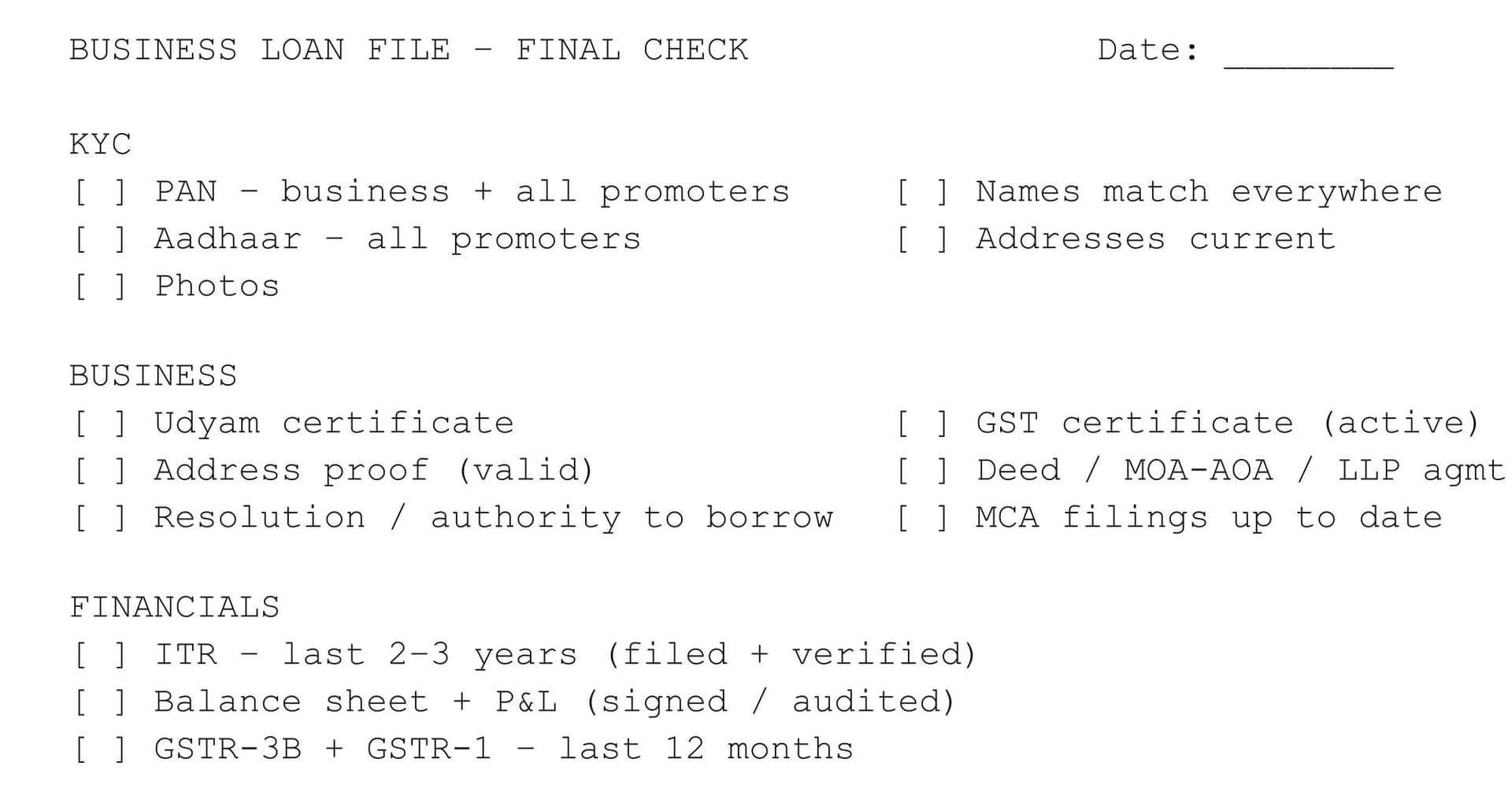
Printable Business Loan Document Checklist
Frequently Asked Questions
What documents are required for a business loan in India?
You will usually need KYC for the business and promoters, Udyam and GST registration, 2–3 years of ITRs and financial statements, 6–12 months of bank statements, and details of existing loans. Term loans and scheme loans need extra documents.
Can I get a business loan without ITR?
Some lenders and schemes, such as Mudra for small amounts, can work with limited income records. Regular term loans usually need filed ITRs. Ask your lender what they accept for your business's age.
Is Udyam registration mandatory for a business loan?
Not every lender requires it for every loan. It is needed to claim MSME benefits, including priority sector treatment and most government schemes. It is free on the official Udyam portal.
How many months of bank statements are needed for a business loan?
Most lenders ask for 6 to 12 months. Provide statements for every business account, not just one. Lenders compare them with your GST and ITR figures.
Why do banks reject files even when all documents are submitted?
Usually because the documents don't agree with each other: names differ, turnover doesn't match across GST and ITR, or an account or loan is missing. The seven checks above are meant to catch exactly this.
Before You Submit
A complete file is not the same as a correct one. Collect from the checklist, then run the seven checks. Most avoidable delays and rejections come from the second step being skipped.
If your loan has already been rejected, start with our guide on why business loans get rejected. If you would like someone to check your documents before you submit, the StartupFlora team can get your documents verified through the Funding Audit. The audit reviews your file. It does not guarantee approval, which is always the lender's decision.