
West Bengal MSME Schemes 2026
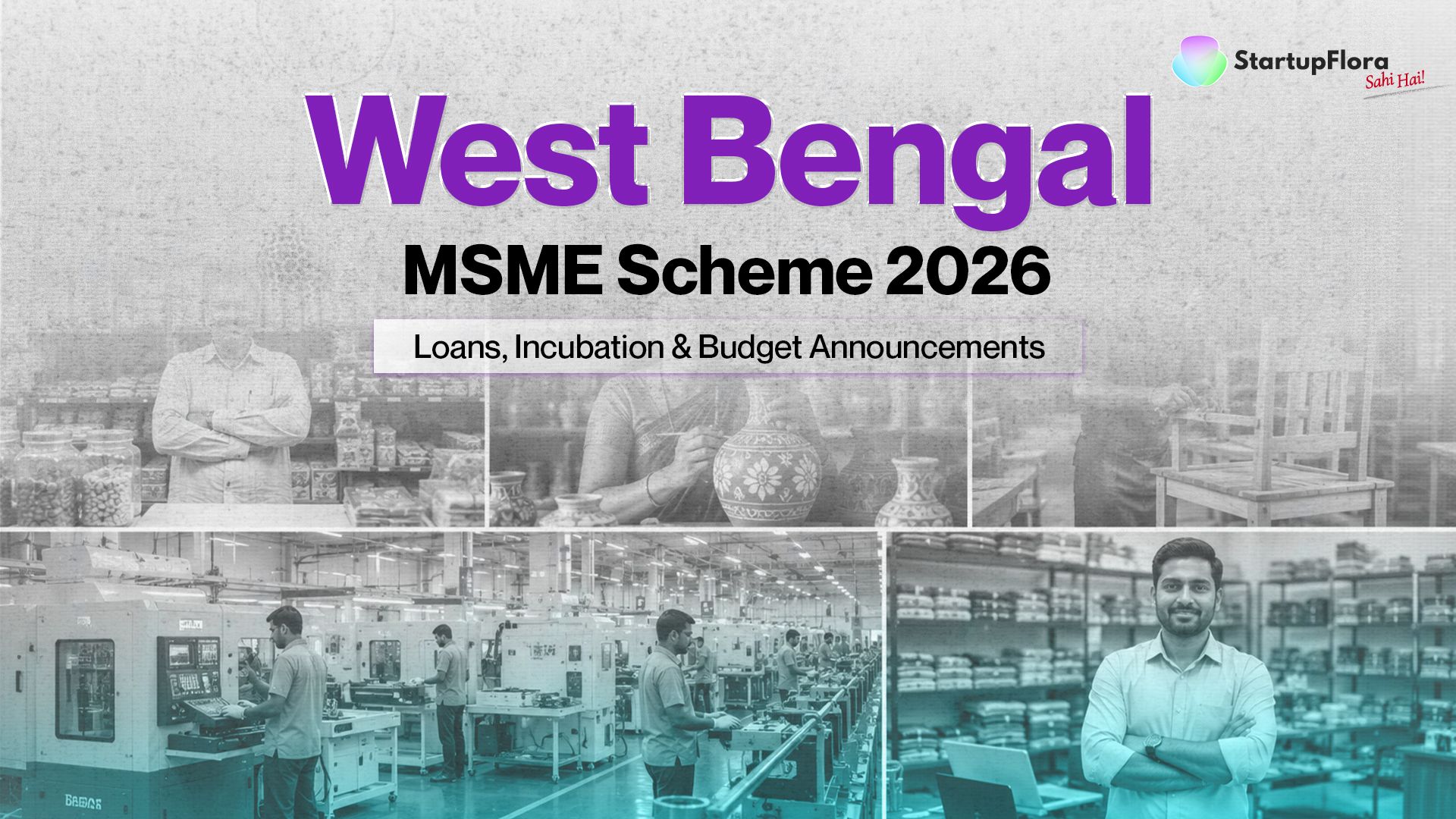

West Bengal is home to nearly 93 lakh MSMEs, one of the largest MSME bases in any Indian state. Yet many of these businesses, from small garment units in Murshidabad to food processing enterprises in Hooghly, struggle to access affordable credit, recover GST paid on sales, or find structured support for growth.
The state government has three active instruments that directly address these gaps: the Banglashree incentive scheme for manufacturing MSMEs, the Bhabishyat Credit Card Scheme (BCCS) for micro-entrepreneurs, and SGST refund provisions under Banglashree. On top of these existing programmes, the West Bengal Budget 2026-27, presented on 22 June 2026, announced a new Startup Policy, a Rs. 40 crore Incubation Fund, a Rs. 60 crore Venture Capital Fund, and a Rs. 5,000 crore industrial incentive framework.
This guide covers all of these. If you run an MSME in West Bengal, are thinking of starting one, or are an advisor helping small businesses navigate government schemes, this article gives you a practical, factual overview of what is available, who qualifies, and how to apply.
What Are West Bengal MSME Schemes?
West Bengal MSME schemes are financial and fiscal support programmes administered by the Department of Micro, Small and Medium Enterprises and Textiles (MSME&T), Government of West Bengal. These programmes are designed to reduce the cost of setting up and running an MSME in the state, improve access to credit, and promote balanced industrial development across districts.
The three main active schemes are:
- Banglashree for MSMEs: a comprehensive fiscal incentive programme offering capital investment subsidies, interest subsidies on term loans, SGST refund, power-related assistance, and stamp duty reimbursement.
- West Bengal Bhabishyat Credit Card Scheme (WBBCCS): a collateral-free credit programme providing up to Rs. 5 lakh at a subsidised interest rate of 4% per annum.
- West Bengal Textile Incentive Scheme 2022: sector-specific support for textile businesses.
Applications for Banglashree are made through the Silpasathi portal. BCCS applications go through the BCCS portal or District MSME offices.
Banglashree Scheme: Fiscal Incentives for Manufacturing MSMEs
What the Banglashree Scheme Offers
Banglashree for MSMEs is a state-level incentive programme launched on 1 April 2020 by the MSME&T Department, Government of West Bengal. It covers manufacturing sector MSMEs that commenced commercial production on or after 1 April 2019.
The scheme includes six categories of incentive:
| Incentive Component | What It Covers | Key Condition |
| Capital Investment Subsidy | Subsidy on investment in plant and machinery | Rate varies by zone (A to E) and enterprise category |
| Interest Subsidy on Term Loan | Subsidy on annual interest liability for up to 5 years on eligible term loans | Only from approved financial institutions; working capital excluded |
| SGST Refund | Refund of net SGST paid (excluding input credit) on sales of manufactured goods | Applied through Commissioner of Commercial Taxes in Form-E annually |
| Stamp Duty Reimbursement | Reimbursement of stamp duty and registration fees on land/building purchase or lease | Micro & Small: Zone A 25%, Zone B 50%, Zone C 75%, Zone D&E 100% |
| Power-Related Assistance | Support for electricity connection costs and related infrastructure | Subject to approval under scheme guidelines |
| Workforce Welfare Assistance | Based on ESI/EPF contributions | Must provide ESI/EPF documentation for eligible workers |
Who Is Eligible for Banglashree?
An MSME is eligible for Banglashree incentives if it meets all of the following:
- It is in the manufacturing sector (service sector enterprises are not covered).
- It commenced commercial production on or after 1 April 2019.
- Its approved project was sanctioned before implementation by a Directorate under MSME&T, the District Industries Centre (DIC), MSME-DI (Government of India), or Food Processing/Horticulture Department.
- The first incentive application is submitted within 12 months of commencing commercial production, or within 12 months of the scheme notification (22 July 2020), whichever is later.
- The enterprise holds a valid Udyam registration.
- The business does not appear on the Banglashree Negative List (which includes tobacco products, pan masala, and aerated drinks).
Existing enterprises can apply for incentives on expansion projects, provided the expansion involves fresh investment in plant, machinery, or building above the minimum threshold.
Additional incentives are available to enterprises wholly owned by women entrepreneurs, SC/ST applicants, or ex-servicemen.
Zone Classification Under Banglashree
Benefits under Banglashree depend on which zone the enterprise's location falls under. The Government of West Bengal classifies locations into Zones A to E, with Zone A covering the most industrially developed areas (lower subsidy rates) and Zones D and E covering remote or backward areas (highest subsidy rates). Zone classification is administered through the District Industries Centres.
Important Note on Banglashree Validity
The original Banglashree scheme was notified as valid from 1 April 2020 to 31 March 2025. As of June 2026, the West Bengal government has not publicly notified a formal extension of this scheme under a new notification. However, the Budget 2026-27 includes a Rs. 5,000 crore industrial incentive framework, which signals continued state support for MSMEs. Applicants should verify the current status directly with their District Industries Centre (DIC) or the Silpasathi portal before applying.
SGST Refund for MSMEs in West Bengal
One of the most practically useful components of Banglashree is the SGST refund provision. Under this, an eligible manufacturing MSME can apply for a refund of the net State Goods and Services Tax (SGST) it has paid on sales of its manufactured goods, excluding any input credit already claimed.
How the SGST Refund Process Works
- At the close of each financial year, the enterprise submits an application to the Commissioner of Commercial Taxes, West Bengal, in Form-E, requesting certification of the total SGST paid (excluding input credit) on manufactured goods sold during that year.
- The enterprise must maintain accounts in a way that clearly shows, at any point, the SGST paid (excluding input credit) on sales of goods covered under the approved Banglashree project.
- Once the certificate is issued by the Commissioner of Commercial Taxes, the DIC works out the admissible refund amount.
- The DIC places a requisition for funds with the Director of MSME, West Bengal.
- After sub-allotment of funds, the DIC/Sub-DIC sanctions the refund amount to the enterprise.
The SGST refund is a meaningful cost reduction for manufacturing MSMEs that pay SGST on their finished goods but cannot fully offset it through input credit. Keep clean GST records and file Form-E within the prescribed window after each financial year.
West Bengal Bhabishyat Credit Card Scheme (WBBCCS): Loans Up to Rs. 5 Lakh
The Bhabishyat Credit Card Scheme (BCCS), administered by the MSME&T Department, is designed for young and first-generation entrepreneurs who cannot access formal bank credit due to lack of collateral or credit history. It provides a collateral-free loan of up to Rs. 5 lakh at a subsidised interest rate.
Key Features of BCCS
| Feature | Detail |
| Maximum Loan Amount | Rs. 5 lakh per applicant/project |
| Interest Rate for Borrower | 4% per annum (remaining interest subsidised by state government) |
| Government Subsidy (Margin Money) | 10% of approved project cost, capped at Rs. 25,000 |
| Collateral Requirement | None (100% guarantee jointly by CGTMSE and Government of West Bengal) |
| Loan Type | Term loan, working capital loan, or composite loan (new or existing business) |
| Eligible Sectors | Manufacturing, service, trading/business, farm sector (dairy, poultry, fisheries, piggery) |
| Application Mode | Online (BCCS portal) or offline through district MSME&T office |
Who Can Apply for BCCS?
- Indian citizen, resident of West Bengal for at least 10 years.
- Age between 18 and 55 years at the time of application.
- Only one member per family (self or spouse) is eligible.
- Motor Transport Workers and Building and Other Construction Workers are also eligible.
- No annual family income bar.
- Government employees (Central or State) and their family members are not eligible.
- Individuals with a history of loan default are not eligible.
How to Apply for BCCS
- Register on the BCCS portal (bccs.wb.gov.in) or collect the form from the District MSME&T Office.
- Fill in personal details, business information, and the proposed project.
- Upload or attach required documents (Aadhaar, Udyam/MSME registration, bank account details, business plan, premises proof, and a photograph).
- Submit to the Block/State Level Screening Committee under MSME&T.
- Approved applications are forwarded to the participating bank for loan sanction.
- Government subsidy (margin money) is credited directly to the beneficiary's bank account after sanction.
West Bengal Budget 2026-27: What MSMEs and Startups Need to Know
The West Bengal Budget for FY 2026-27 was presented on 22 June 2026 by Finance Minister Swapan Dasgupta. For MSMEs, startups, and entrepreneurs, the budget contained several specific announcements.
New Startup Policy
The government announced a new Startup Policy, expected to be notified within three months of the budget. The policy is intended to create a structured framework for grants, incubation, procurement access, mentorship, and university-startup collaboration. This has been a long-standing gap in West Bengal's startup ecosystem.
Rs. 40 Crore Incubation Fund
A dedicated Incubation Fund of Rs. 40 crore has been announced to support early-stage ventures. This can cover ideation, proof-of-concept work, prototyping, validation, and mentoring at the pre-commercial stage. The fund is expected to benefit student founders, first-time entrepreneurs, and research-led innovation projects.
Rs. 60 Crore Venture Capital Fund
Alongside the incubation fund, the budget proposes a Rs. 60 crore Venture Capital Fund. Combined, the two funds amount to Rs. 100 crore in dedicated startup support, the first time West Bengal has committed public venture capital at this scale.
Rs. 5,000 Crore Industrial Incentive Framework
The budget introduces an investment-promotion framework with an allocation of Rs. 5,000 crore. This is intended to incentivise industrial development, attract private capital, and support green energy and emerging technologies. A single-window clearance system for projects above Rs. 100 crore investment is also proposed to reduce approval delays.
Other Business-Relevant Announcements
- GCC (Global Capability Centre) Policy to attract technology-services investment.
- AI Mission and incentives for AI data centre development.
- Proposed semiconductor unit in Durgapur.
- IT Park in Siliguri to promote technology entrepreneurship in North Bengal.
- 24x7 business operations permission.
- Legislation to protect businesses from syndicate charges and informal extortion.
- Revival of the Calcutta Stock Exchange.
| Budget Announcement | Amount | Relevance for MSMEs/Startups |
| Incubation Fund | Rs. 40 crore | Early-stage founders, student entrepreneurs, proof-of-concept projects |
| Venture Capital Fund | Rs. 60 crore | Growth-stage startups needing equity capital |
| Industrial Incentive Framework | Rs. 5,000 crore | Manufacturing MSMEs, large-scale industrial investment |
| Science & Technology Talent Fund | Rs. 50 crore | Deep tech, research-led enterprises, talent attraction |
| IT Park, Siliguri | TBA | North Bengal tech startups, IT services MSMEs |
| GCC Policy | Policy | Technology services, software MSMEs targeting MNC contracts |
Union Budget 2026-27: MSME Support at the National Level
West Bengal MSMEs can also access the central government schemes announced in the Union Budget 2026-27, presented on 7 June 2026.
- Rs. 10,000 crore SME Growth Fund for structured equity support to high-potential MSMEs based on performance criteria.
- Rs. 2,000 crore additional infusion into the Self-Reliant India (SRI) Fund for micro enterprises.
- Mandatory TReDS transaction settlement for all MSME purchases by Central PSEs, improving payment speed.
- CGTMSE credit guarantee for invoice discounting on the TReDS platform.
- Linkage of GeM (Government e-Marketplace) with TReDS to accelerate financing of government purchases.
West Bengal MSMEs registered on Udyam are eligible for all central schemes. The MSME Champions Scheme, ZED Certification, and Lean Scheme are all currently active nationally.
Documents Required for West Bengal MSME Schemes
For Banglashree
- Udyam Registration Certificate
- Approved project report
- Loan sanction and disbursement letters from bank/financial institution
- Audited balance sheets for the last two financial years
- Bills and receipts for plant and machinery purchased
- Land deed, lease agreement, or rent receipts
- Mutation and conversion certificate of land (if applicable)
- WBPCB Consent to Operate
- SGST records and trade license
- First electricity bill for the unit
- Memorandum of Association and Articles of Association (for companies), or Partnership Deed
- List of Directors/Partners/Owners
- SC/ST certificate (if applicable for additional incentives)
- Self-declaration as per the scheme format
For Bhabishyat Credit Card Scheme (BCCS)
- Aadhaar Card (identity and address proof)
- Udyam or MSME Department registration certificate
- Bank account details (passbook or cancelled cheque)
- Business plan or project proposal
- Premises proof (ownership or rent agreement)
- Recent passport-size photograph
- Proof of West Bengal residency for 10 years (ration card, voter ID, or similar)
How to Apply: Step-by-Step
Applying Under Banglashree (via Silpasathi Portal)
- Visit silpasathi.wb.gov.in and create or log into your account using credentials or OTP.
- From the dashboard, go to 'ALL SERVICES' and select 'MSME Incentive'.
- Click 'Create CAF' to generate a Common Application Form (CAF) ID.
- Fill in the eligibility form. Save and continue.
- Complete all mandatory fields in the CAF. Upload required documents.
- In the 'APPLY SUBSIDY' section, review and confirm year-wise subsidy items.
- Preview the application, verify, and submit. An application reference number is generated on submission.
- Track application status on the dashboard. The inspecting officer from DIC will conduct an enquiry and submit a report.
- Approval or rejection is communicated to the applicant. After approval, funds are sub-allotted from the Director, MSME, to your DIC/Sub-DIC.
Helpdesk: Protiti, 23, Abanindranath Tagore Sarani (Camac Street), Kolkata - 700017, West Bengal.
Applying Under BCCS (Bhabishyat Credit Card)
- Visit bccs.wb.gov.in and register with your mobile number and Aadhaar details.
- Fill in the application form with personal information, project details, and proposed loan amount.
- Upload required documents digitally.
- Submit the application. It goes to the Block/State Level Screening Committee of MSME&T.
- If approved by the committee, your application is forwarded to the designated bank.
- The bank sanctions the loan. Government subsidy (margin money) is credited to your account.
- Receive the credit card linked to the sanctioned loan amount. Draw funds as needed for the approved project.
Key Benefits of West Bengal MSME Schemes
Direct Cost Reduction
Banglashree's capital investment subsidy, interest subsidy, and SGST refund reduce the effective cost of setting up and operating a manufacturing unit. For a unit investing Rs. 50 lakh in machinery in a Zone C district, the cumulative benefit across incentive components can be substantial.
Collateral-Free Credit Under BCCS
The Bhabishyat Credit Card Scheme removes the most common barrier to MSME credit: collateral. With 100% guarantee coverage from CGTMSE and the state government, a first-generation entrepreneur with a viable project idea can borrow up to Rs. 5 lakh at 4% per year, without pledging any asset.
Support for Women, SC/ST Entrepreneurs
Banglashree provides additional incentive percentages for enterprises wholly owned by women, SC/ST community members, or ex-servicemen. This translates to higher subsidy rates on capital investment and other components compared to general applicants in the same zone.
Simplified Single-Window Application
The Silpasathi portal combines what were previously separate applications for each incentive component into a single Common Application Form. This reduces the paperwork burden and the number of visits to government offices.
Sector Breadth Under BCCS
Unlike Banglashree (which covers only manufacturing), BCCS covers manufacturing, services, trading, and farm-based activities including dairy, poultry, fisheries, and piggery. This makes it accessible to a much wider group of micro-entrepreneurs.
Banglashree vs. BCCS: Key Differences
| Feature | Banglashree | Bhabishyat Credit Card (BCCS) |
| Sector Coverage | Manufacturing only | Manufacturing, service, trading, farm sector |
| Type of Support | Fiscal incentives (subsidy, refund, reimbursement) | Collateral-free credit at subsidised rate |
| Maximum Benefit | Varies by zone and investment; can be significant for larger projects | Up to Rs. 5 lakh loan; Rs. 25,000 subsidy |
| Working Capital | Not covered | Covered (term, working capital, or composite loan) |
| Eligibility (Age) | No age restriction | 18 to 55 years |
| Udyam Required | Yes | Yes |
| Application Portal | Silpasathi (silpasathi.wb.gov.in) | BCCS portal (bccs.wb.gov.in) |
| Best For | Manufacturing MSMEs with fixed-asset investment | First-generation micro-entrepreneurs needing working capital or startup finance |
Common Mistakes to Avoid
Applying Before Getting Project Approval
Under Banglashree, the project must be approved by the DIC or another designated authority before implementation begins. Starting construction or purchasing machinery without prior approval is one of the most common reasons applications are rejected.
Missing the 12-Month Application Window
The first incentive application under Banglashree must be submitted within 12 months of commencing commercial production. This deadline is firm. Applicants who miss it lose eligibility for that year's benefits, even if the enterprise is otherwise fully compliant.
Assuming Banglashree Covers Working Capital
Banglashree's interest subsidy applies only to term loans for fixed assets, such as plant and machinery. Working capital loans are not covered. Entrepreneurs who need credit for raw materials or operational costs should look at BCCS or commercial bank facilities.
Not Maintaining SGST Records Separately
The SGST refund under Banglashree requires the enterprise to maintain accounts that clearly show, at all times, the SGST paid (excluding input credit) on sales of manufactured goods under the approved project. Units that do not maintain this separation of records struggle to obtain certification from the Commercial Taxes Commissioner.
Applying for Both Banglashree and Another State/Central Incentive for the Same Item
Banglashree explicitly excludes enterprises that have claimed the same incentive under any other Government of India or State Government scheme. Check carefully before applying to avoid double-claiming, which can result in rejection and recovery of earlier disbursements.
Frequently Asked Questions (FAQs)
1. Is Udyam registration mandatory for West Bengal MSME schemes?
Yes. Both Banglashree and BCCS require a valid Udyam Registration. Register at udyamregistration.gov.in before applying to either scheme.
2. Can an existing MSME apply for Banglashree?
Yes. Existing enterprises are eligible for incentives on expansion projects, as long as they invest fresh money in new plant, machinery, or building space above the minimum threshold, and the expansion project is approved by the DIC before it begins.
3. What is the SGST refund process under Banglashree?
At the end of each financial year, the enterprise applies to the Commissioner of Commercial Taxes in Form-E. The Commissioner certifies the net SGST paid. The DIC then works out the admissible refund and sanctions it after receiving sub-allotted funds from the Director, MSME.
4. What industries are excluded from Banglashree?
Tobacco products, pan masala, and aerated drinks are on the Banglashree Negative List and cannot claim benefits. Refer to Annexure-IV of the Banglashree scheme document for the full list.
5. Under BCCS, can I apply for a second loan?
Yes, but not immediately. A new unit set up under BCCS can be considered for a second dose of capital support for machinery or expansion only after two years of implementation of the first project.
6. What is the Rs. 40 crore Incubation Fund and when will it be available?
The Rs. 40 crore Incubation Fund was announced in the West Bengal Budget 2026-27 (presented 22 June 2026). The new Startup Policy, under which this fund will operate, is expected to be notified within three months of the budget. Until the policy is formally notified, detailed application procedures are not yet available. Check the Silpasathi portal and the MSME&T website for updates.
7. Can service sector businesses benefit from any WB MSME scheme?
Banglashree covers manufacturing only. BCCS, however, covers service sector businesses. The West Bengal Textile Incentive Scheme 2022 covers textile-related services. The proposed Startup Policy is expected to have broader sectoral coverage.
8. What is the difference between the Incubation Fund and the Venture Capital Fund announced in Budget 2026-27?
The Rs. 40 crore Incubation Fund targets pre-commercial enterprises: idea-stage founders, proof-of-concept projects, and research-linked innovations. The Rs. 60 crore Venture Capital Fund targets growth-stage ventures that have moved past the prototype stage and need equity capital to scale. Both are part of the state's new startup ecosystem framework.
9. Can I apply for both Banglashree and BCCS simultaneously?
Banglashree and BCCS serve different purposes. Banglashree supports fixed-asset investment in manufacturing. BCCS provides working capital credit. If your enterprise is a manufacturing MSME and you need both fixed-asset incentives and working capital credit, you can potentially use both, provided you do not claim the same subsidy component under both schemes. Consult your DIC for confirmation before applying.
10. Where do I apply for Banglashree, and who is the contact for help?
Applications go through the Silpasathi portal at silpasathi.wb.gov.in. For technical or application queries, contact Protiti at 23, Abanindranath Tagore Sarani (Camac Street), Kolkata 700017. Your local District Industries Centre (DIC) is the primary point of contact for scheme-related queries.
Conclusion
West Bengal's MSME support framework in 2026 combines three active schemes with a set of ambitious new announcements from the state budget. The Banglashree scheme remains the most comprehensive fiscal incentive package for manufacturing MSMEs, covering capital subsidies, interest subsidies, SGST refunds, and more. The Bhabishyat Credit Card Scheme fills the credit gap for first-generation micro-entrepreneurs who need working capital without collateral.
The Budget 2026-27 adds a new layer with its Rs. 40 crore Incubation Fund, Rs. 60 crore Venture Capital Fund, and Rs. 5,000 crore industrial incentive framework. Whether these translate into accessible, well-administered programmes depends on timely policy notification and ground-level implementation.
For MSME owners and entrepreneurs in West Bengal: check your Udyam registration first, then assess which scheme matches your stage and sector. For manufacturing units with fixed-asset investments, Banglashree is the right starting point. For micro-enterprises needing credit, BCCS is faster to access and covers a broader range of activities.
Apply through Silpasathi (silpasathi.wb.gov.in) for Banglashree and through bccs.wb.gov.in for BCCS. Visit your local DIC if you have questions about zone classification or project approval.