
MGT-7 vs MGT-7A: Which Annual Return Does Your Company File?


Every company in India files an annual return with the Registrar of Companies under Section 92 of the Companies Act, 2013. It is a snapshot, as at 31 March, of who owns the company, who runs it and what meetings it held.
There are two versions of that return, and the first job is choosing the right one:
- MGT-7A, the abridged return, for one person companies and small companies
- MGT-7, the full return, for every other company
Both are due within 60 days of the AGM. For FY 2025-26, MCA has allowed both to be filed without additional fees until 31 January 2027.
Which Form Is Yours? A 30-Second Decision
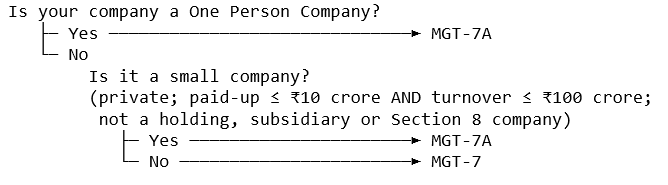
The small company limits rose to ₹10 crore and ₹100 crore from 1 December 2025. Many companies that filed MGT-7 last year may now qualify for MGT-7A. Check with the small company test before you file, and confirm the position as at the year end with your company secretary.
Side by Side
| Point | MGT-7A | MGT-7 |
| Who files | OPCs and small companies | All other companies |
| Length | Short, fewer disclosures | Full disclosures |
| Signed by | One director (plus CS if appointed) | Director and CS; a practising CS for some companies |
| MGT-8 certification | Not needed | Needed for listed companies and companies with paid-up capital of ₹10 crore or more or turnover of ₹50 crore or more |
| Due date | 60 days from AGM (OPC: 60 days from the deemed AGM date) | 60 days from AGM |
| Late fee | ₹100 per day, no cap | ₹100 per day, no cap |
| Penalty relief | Halved under Section 446B | Full penalty |
What the Annual Return Actually Asks For
Think of it as six questions the ROC asks every year.
Who Are You?
Name, CIN, registered office, principal business activities, and holding, subsidiary or associate companies.
Who Owns You?
Share capital, number of shareholders, and the shareholding pattern. On V3, the pattern is more detailed: promoter or not, resident or not, and gender-wise.
What Changed?
Share transfers during the year, and any shares issued, bought back or forfeited.
Who Runs You?
Directors and key managerial personnel, appointments and exits, and their remuneration. Changes should already be on record through DIR-12.
When Did You Meet?
Board, committee and general meetings held, with dates and attendance. A small company needs at least two board meetings a year.
Any Defaults?
Penalties, compounding and pending proceedings, plus debentures and indebtedness where relevant.
How Filing Works on the V3 Portal
- Hold the AGM and note its date. OPCs and small companies need not hold an AGM in some cases, and OPCs have a deemed date for the 60-day count.
- File AOC-4 first, within 30 days of the AGM. The annual return refers to the same year.
- Get the shareholder list ready. The V3 form takes large tables through an Excel upload.
- Fill the web form for MGT-7 or MGT-7A on the MCA V3 portal.
- Attach the list of shareholders and debenture holders, MGT-8 where required, and any optional attachments.
- Sign with the director's DSC (and the CS's, if applicable), pay the fee and save the SRN.
Keep the director's DIN active; a deactivated DIN blocks signing.
FY 2025-26 Dates at a Glance
| Situation | Statutory due date | No-additional-fee window |
| AGM on 30 September 2026 | 29 November 2026 | Up to 31 January 2027 |
| AGM earlier | 60 days from that AGM | Up to 31 January 2027 |
File after 31 January 2027, and additional fees run from the original due date, not from the end of the window. The relaxation covers the additional fee only; it does not change the statutory time limit.
The Cost of Missing It
| What applies | Amount |
| Additional fee | ₹100 per day, no cap, counted separately for each form |
| Section 92(5) penalty, company | ₹10,000 plus ₹100 per day of continuing failure, up to ₹2 lakh |
| Section 92(5) penalty, each officer in default | ₹10,000 plus ₹100 per day, up to ₹50,000 |
| OPCs and small companies | Section 446B halves the penalty |
| Three consecutive years unfiled | Directors risk disqualification and the company risks strike-off |
Before You Click Submit
- ☐ Form chosen using the current small company limits
- ☐ AOC-4 for the same year already filed
- ☐ Shareholding matches the register of members and share transfer records
- ☐ Director changes during the year already filed in DIR-12
- ☐ Meeting dates match the minutes
- ☐ MGT-8 obtained, if required
- ☐ Company not tagged "ACTIVE non-compliant" (see INC-22A)
FAQs
What is MGT-7? MGT-7 is the e-form for filing a company's annual return with the ROC under Section 92 of the Companies Act, 2013. It covers shareholding, directors, meetings and related details as at the year end.
What is the difference between MGT-7 and MGT-7A? MGT-7A is the shorter annual return for one person companies and small companies. Every other company files the full MGT-7.
What is the MGT-7 due date for FY 2025-26? Within 60 days of the AGM: 29 November 2026 for an AGM on 30 September 2026. MCA has allowed filing without additional fees until 31 January 2027.
Who needs MGT-8? Listed companies, and companies with paid-up capital of ₹10 crore or more or turnover of ₹50 crore or more, need the annual return certified by a practising company secretary in Form MGT-8.
What is the penalty for not filing MGT-7? An additional fee of ₹100 per day with no cap, plus a penalty under Section 92(5) of ₹10,000 and ₹100 per day, up to ₹2 lakh for the company and ₹50,000 for each officer in default.
Does a dormant company file MGT-7? Yes. Every company that existed during the year files an annual return, even with no business.
In Short
Choose the form first, using the new small company limits. File AOC-4, then the annual return within 60 days of the AGM. For FY 2025-26, aim to be done by 31 January 2027 at the latest.
Want it handled for you? The StartupFlora team files MGT-7 and MGT-7A along with AOC-4 under its annual company filing service. Talk to the StartupFlora team.
Disclaimer: StartupFlora is a consultancy service provider specializing in startup consultation. We are not associated or in collaboration with any Government/Non-Government Agency / Institutions / Organisation / Department. For service payments, please ensure all transactions are made directly to our official company account.